Hi, this is Higashi.
When you head out in an electric car in winter, how much range do you lose by turning on the heat? An electric heater and a heat pump can deliver the same warmth while drawing different amounts of power.
I used the Python program from my earlier posts to map three scenarios starting at Tokyo Station: no heating, an electric heater, and a heat pump.
Converting heating power to Wh/km
The battery capacity is 60 kWh and the state of charge (SOC) is 10%, so there’s 6,000 Wh available. Driving alone uses 150 Wh/km, and the average speed is 60 km/h. When the heating is on, both systems deliver 2 kW of heat to the cabin.
For the electric heater, I assumed all the electrical power becomes heat, so delivering 2 kW of heat takes 2 kW of electricity. The heat pump has a coefficient of performance (COP) of 1.5 in this example, so it draws about 1.33 kW to deliver the same heat (2 ÷ 1.5). COP tells you how much heat the system delivers per unit of electricity it uses.
At an average of 60 km/h, you cover 60 km in an hour. Divide the 2,000 Wh the electric heater uses in that hour by 60 km and you get about 33.3 Wh/km for heating. Add that to the 150 Wh/km used for driving.
| Scenario | Heating power draw | Energy use with heating | One-way distance limit at 10% SOC | Range loss vs. no heating | Full-charge equivalent |
|---|---|---|---|---|---|
| No heating | 0 kW | 150.0 Wh/km | 40.0 km | 0% | 400.0 km |
| Electric heater | 2.00 kW | 183.3 Wh/km | 32.7 km | About 18.2% | 327.3 km |
| Heat pump (COP 1.5) | About 1.33 kW | 172.2 Wh/km | 34.8 km | About 12.9% | 348.4 km |
Finding reachable roads for each heating mode with Python
I reused the code for loading roads and drawing them on a map from my post on mapping EV driving range from Tokyo and Osaka Stations. Here, I added the heating load to calculate a distance limit for each scenario.
energy_wh = 60 * 1000 * 0.10
speed_kmh = 60
base_wh_per_km = 150
heat_output_kw = 2
cop = 1.5

heater_kw = {
    "No heating": 0,
    "Electric heater": heat_output_kw,
    "Heat pump": heat_output_kw / cop,
}

# Convert heating power to Wh/km and calculate the one-way distance limit.
limits_km = {}
for mode, power_kw in heater_kw.items():
    heating_wh_per_km = power_kw * 1000 / speed_kmh
    limits_km[mode] = energy_wh / (base_wh_per_km + heating_wh_per_km)

# Calculate shortest road distances once, up to the longest limit of 40 km.
_, _, distances = shortest_distances(
    graph, coords, origin, max(limits_km.values()) * 1000
)

for mode, limit_km in limits_km.items():
    left, right, full, partial = reachable_segments(
        u, v, lengths, direction, distances, limit_km * 1000
    )
    # Draw fully and partially reachable road segments for this scenario.
I used major roads from OpenStreetMap and started at a point on the road network near Tokyo Station, taking one-way streets into account. The starting point and network are the same in all three scenarios, so I ran the shortest-distance calculation once and used each distance limit to pick out the reachable roads.
Comparing driving ranges from Tokyo Station on a map
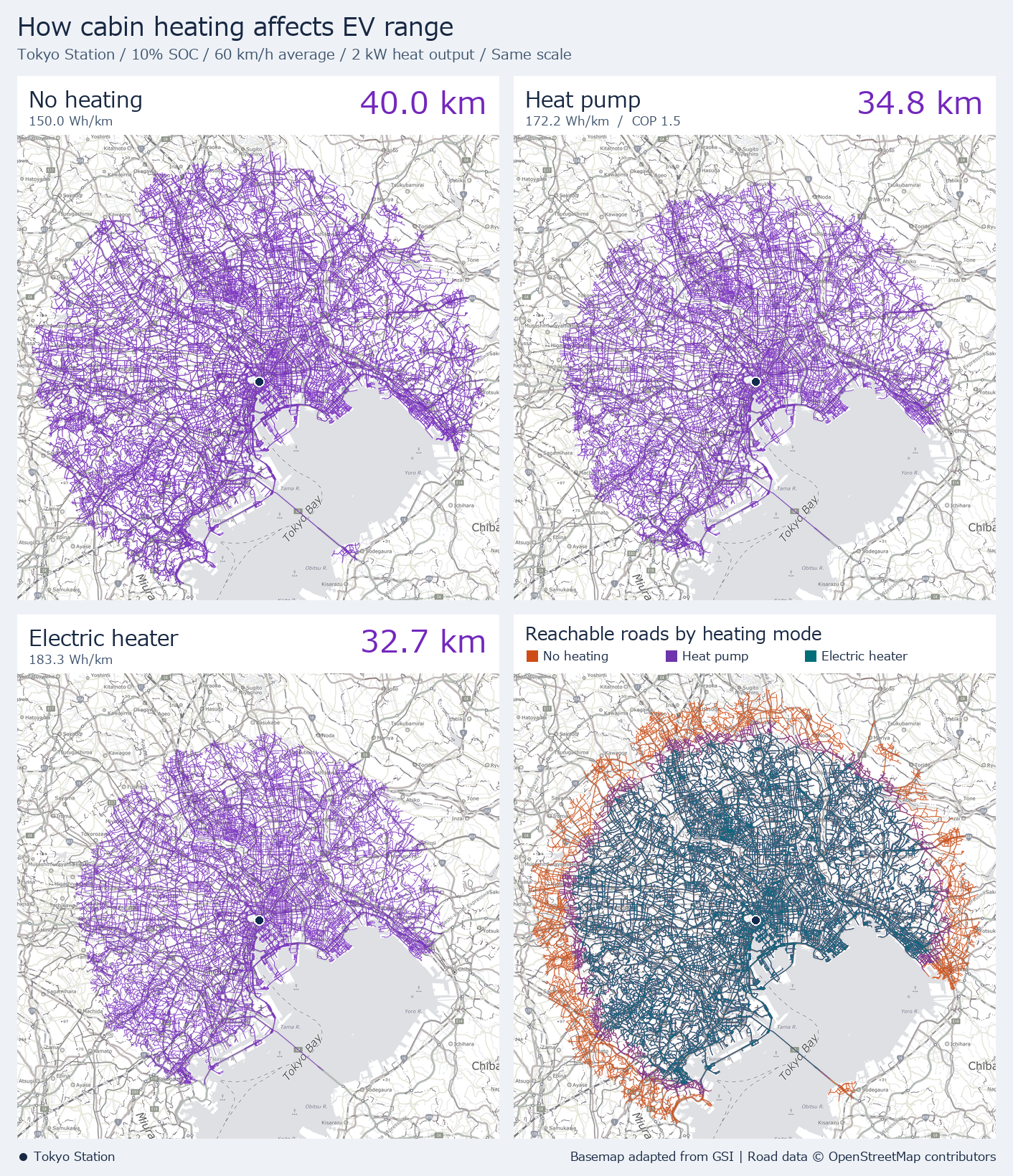
All three maps cover the same area at the same scale. The bottom-right overlay shows the reachable roads in three colors. Teal marks the roads within range with the electric heater, which are also reachable in the other two scenarios. A heat pump gets you as far as the purple sections, and no heating takes you farther along the orange sections.
For example, in the direction of the Tokyo Bay Aqua-Line, the road point near Kisarazu-Kaneda came out at about 38.4 km. That’s within the 40.0 km limit with no heating. Both the electric heater (32.7 km) and the heat pump (34.8 km) reach their limits before that point.
How long did it take?
On my Windows setup, generating one comparison image for the Japanese version took 98.89 seconds (about 1 minute and 39 seconds). That includes reading the previously downloaded nationwide road data, building the road network, calculating all three scenarios, fetching the basemap, and saving the PNG with Pillow. The initial road data download was outside the timed run.
How big is the difference in percentage terms and on a full charge?
At 10% SOC, the difference between the electric heater and the heat pump is about 2.1 km. That can look small, but compared with no heating, the electric heater cuts range by about 18.2% and the heat pump by about 12.9%. Using the electric heater as the baseline, the heat pump gives about 6.5% more range in this example.
Now let’s raise the available energy from 6 kWh to 60 kWh and keep everything else the same. The full-charge equivalents are 400.0 km with no heating, 327.3 km with the electric heater, and 348.4 km with the heat pump. The two heating modes take off about 72.7 km and 51.6 km, respectively, compared with no heating. The gap between them is about 21.1 km. With constant energy use per kilometer, range scales with available energy, so the full-charge numbers are ten times the 10% SOC estimates before rounding.
Checking for a heat pump when choosing an EV
Under these conditions, the heat pump used less electricity to deliver the same heat, leaving more energy for driving. If winter range matters to you when choosing an EV, it’s worth checking whether the model and trim you’re considering come with a heat pump.
The COP of 1.5 is an assumption for this example. COP varies with the vehicle and outside temperature, and changing the cabin temperature setting changes how much heat you need. I held the average speed, heat output, and COP constant. The estimate leaves out the effects of cold on battery performance and driving energy use, a reserve for reaching a charger, and turn restrictions at individual intersections.
If you’re curious how energy consumption changes what you can reach on a map, see my earlier comparison at 120, 150, and 200 Wh/km.
See you next time!


コメント