Hi, Higashi here.
In my last post, I held the inlet speed of a U-bend constant and checked the inlet pressure once the flow settled. This time I wanted to watch what happens as the flow slows down. The moment the inlet speed reaches zero, does the air in the bend come to a stop too?
Speed up for 0.1 seconds, then slow down for 0.1 seconds
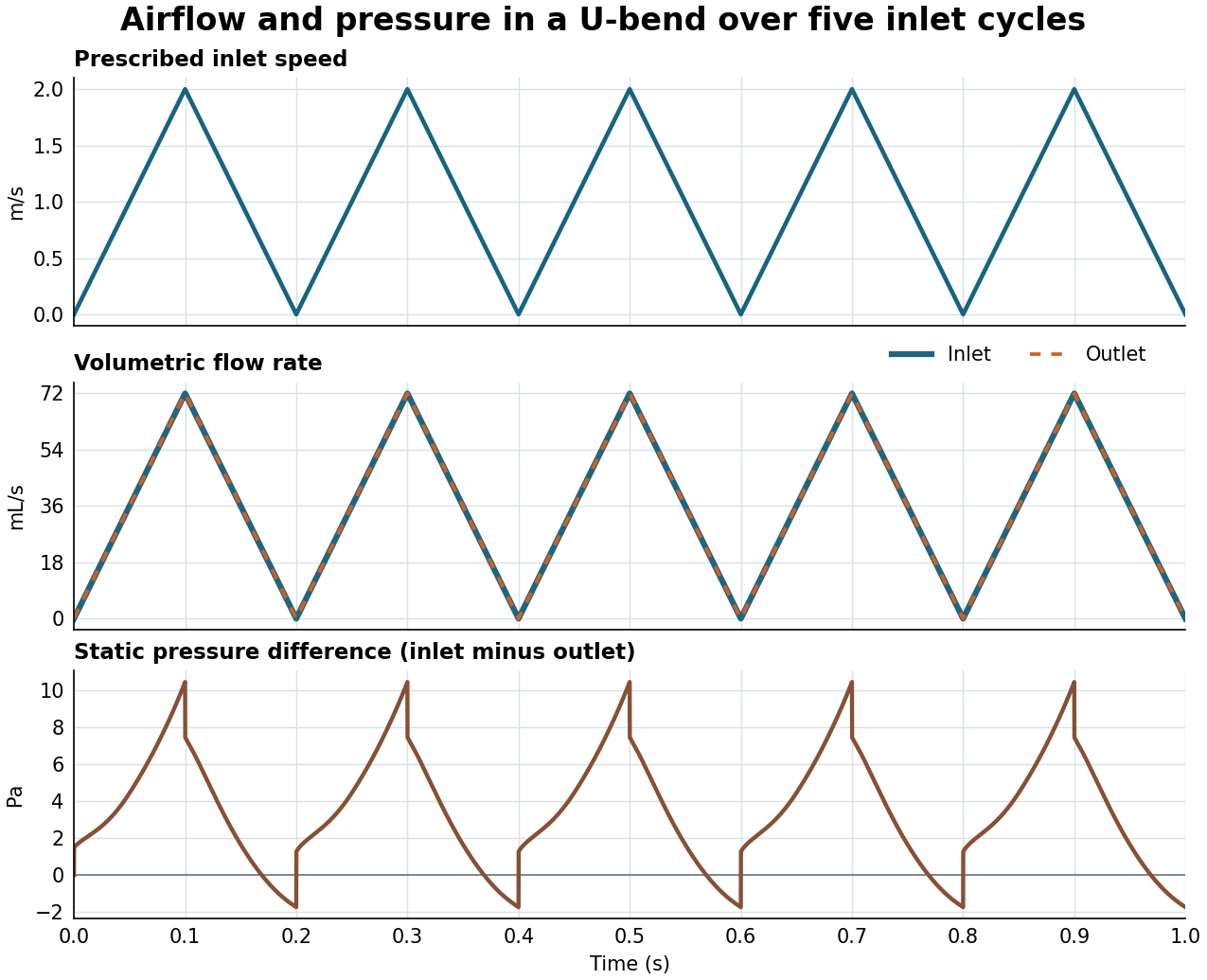
I used the same U-shaped duct as before, with a 6 mm × 6 mm square cross section. The air starts at rest throughout the duct. I increased the inlet speed at a constant rate from 0 to 2 m/s over 0.1 seconds, then brought it back to zero over the next 0.1 seconds. Five cycles take exactly one second.
The mesh has 0.5 mm cells, with 19,872 cells in the fluid region. As before, I used air at 300 K, set the outlet to atmospheric pressure, and used the RNG k–ε turbulence model. The Python solver advances the flow by 0.00004 seconds at a time. At each step, it updates the flow field and carries the result into the next step. That lets us follow the flow as it changes, which is what a transient simulation does.
Watch the air move through the bend
Air enters at the lower left, turns around at the right-hand end, and exits at the upper left. Yellow means faster air and dark purple means slower air. I placed a probe near the outer wall of the bend and marked it A so we can track the speed at the same spot throughout the animation.
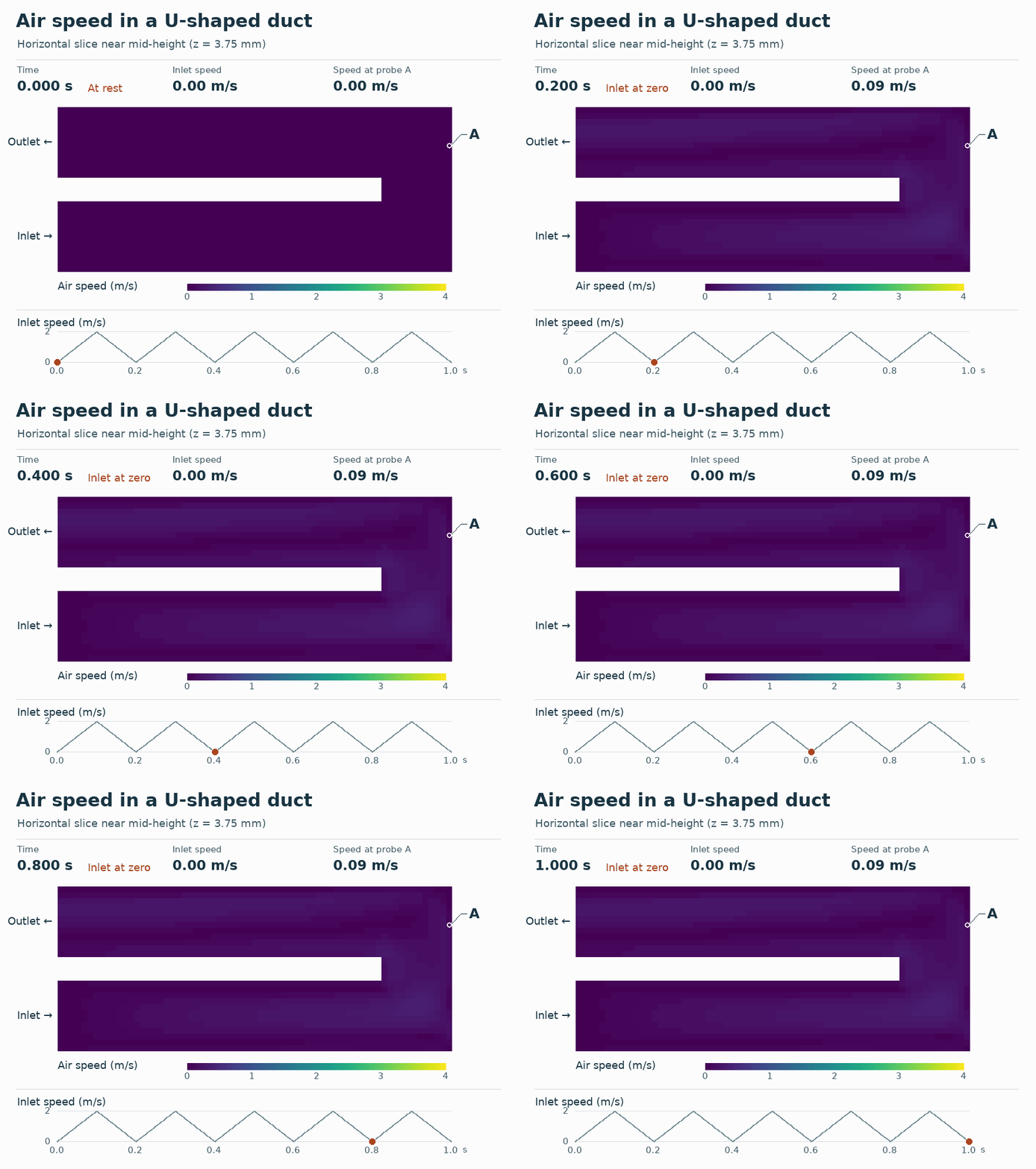
Watch the two moments in the first cycle when the inlet reads 1.00 m/s. On the way up, at 0.05 s, the speed at A is 0.48 m/s. After the inlet peaks at 2 m/s and comes back down to 1 m/s, at 0.15 s, the same probe reads 0.94 m/s. Nearly twice as fast in the bend, even though the inlet reads exactly the same.
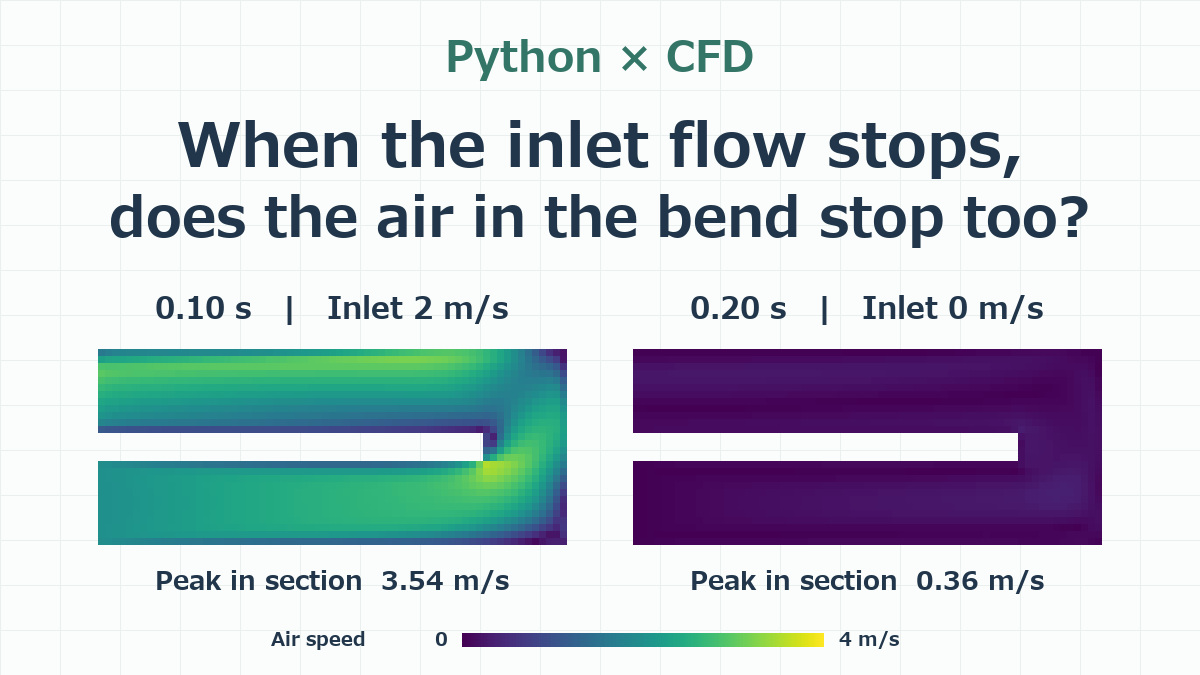
Now compare 0.00 s with 0.20 s. At the start, all the air is at rest. At 0.20 s, the inlet is back at zero, yet air in the bend is still moving at up to 0.36 m/s. The net flow rate through both the inlet and outlet is zero at that instant. I also checked the velocity directions in the saved data. Within a single cross section of the return leg, some air was moving toward the outlet while some was moving back toward the bend.
One inlet speed, three different pressure readings
In the steady simulation, it took a pressure difference of 3.01 Pa to maintain an inlet speed of 1 m/s. How does that compare with the two times the inlet passes through 1 m/s here? In all three cases, I averaged the static pressure over a cross section 0.25 mm inside the inlet and subtracted the static pressure at the outlet face. How Much Inlet Pressure Does It Take to Quadruple the Flow Through a U-Bend?
| When the inlet speed is 1 m/s | Static pressure difference (inlet minus outlet) |
|---|---|
| Accelerating (0.05 s) | 4.44 Pa |
| Steady at 1 m/s | 3.01 Pa |
| Decelerating (0.15 s) | 1.66 Pa |
It takes a bigger push at the inlet to speed up the air already in the duct. As the inlet slows down, the moving air tends to keep going, so it takes less inlet pressure to sustain the same flow rate. Near the end of the slowdown, the pressure difference actually reaches about −1.73 Pa. For a moment the inlet pressure is lower than the outlet pressure. That change in sign is a reminder that the static pressure difference in a transient flow also reflects the air’s acceleration.
How long did it take to simulate one second?
I split that second into 25,000 time steps. On my PC, advancing the flow through those steps took 4 min 13 s. Including mesh generation, initial compilation, and saving the results brought the total to 4 min 20 s. I made the GIF separately.
There’s a quick way to check the result. The inlet speed averages 1 m/s over the run, so 36 mL of air should pass through a 36 mm² opening in one second. The simulation gave 36.0 mL at both the inlet and outlet. I also repeated the first cycle with half the time step. The largest change in the static pressure difference, comparing the two runs at matching times, was about 0.053 Pa.
My favorite pair of frames is still 0.00 s and 0.20 s. The inlet display reads zero in both. Only one of those frames shows a duct full of still air. I’ve run this same U-bend at several steady speeds, and those two frames show something I’d have missed by waiting for the flow to settle.


コメント