Hi, Higashi here.
Suppose you leave Cape Sata, at the southern tip of Kyushu in Japan, in a fully charged EV. On the way, you stop once at a highway service area and plug in for 15 minutes while you get a coffee. How far from the cape can you get?
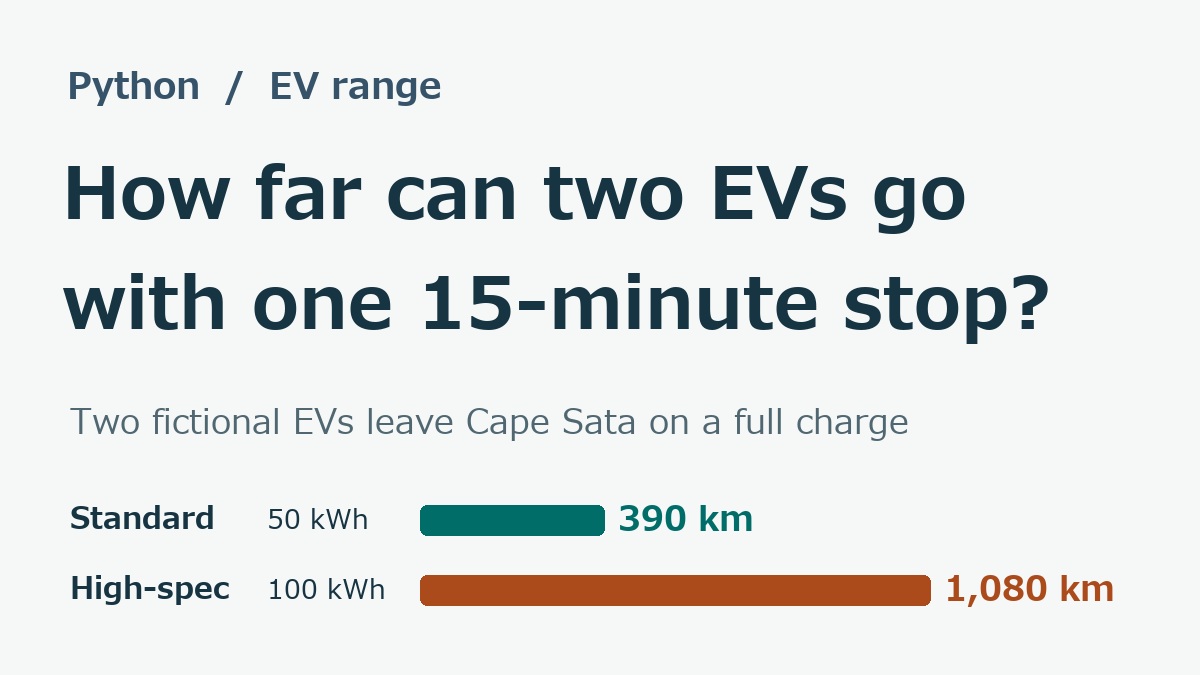
I tried this with two hypothetical EVs. The standard model has 50 kWh of usable battery capacity, and the high-spec model has 100 kWh. Both stop to charge at 10%, leave 15 minutes later, and drive until the battery is back at 10%. The total distance from Cape Sata is 390 km for the standard model and 1,080 km for the high-spec model. On the road map, that puts Hakata Station in Fukuoka within reach of the first car and Nagoya Station within reach of the second.
Two batteries, the same 15-minute stop
I’ll call the two cars the standard model and the high-spec model. The table shows how much energy the battery can hold, how far each car can drive on one kilowatt-hour, and how quickly it can charge.
| Assumption | Standard model | High-spec model |
|---|---|---|
| Usable battery capacity | 50 kWh | 100 kWh |
| Distance per kWh | 6 km/kWh | 8 km/kWh |
| Average power added to the battery over 15 minutes | 80 kW | 180 kW |
Why 50 kWh? A UC Davis chart puts the average battery capacity of a battery-electric vehicle in Japan at 50 kWh in 2022. The chart leaves open whether that is total or usable capacity. For this example, I gave the standard model 50 kWh of usable capacity. Since cars sold in Japan can have batteries larger than 100 kWh, I used 100 kWh of usable capacity for the high-spec model. Average battery capacity by country (slide 8) · A large-battery example from the Japanese market
Charging power rises and falls during a real session. Here, 180 kW is the average rate at which energy goes into the battery over the whole stop. Both cars arrive with warm batteries and get a high-power charger to themselves. The clock counts 15 minutes of actual charging in each case.
One charging stop brings the total to 390 km or 1,080 km
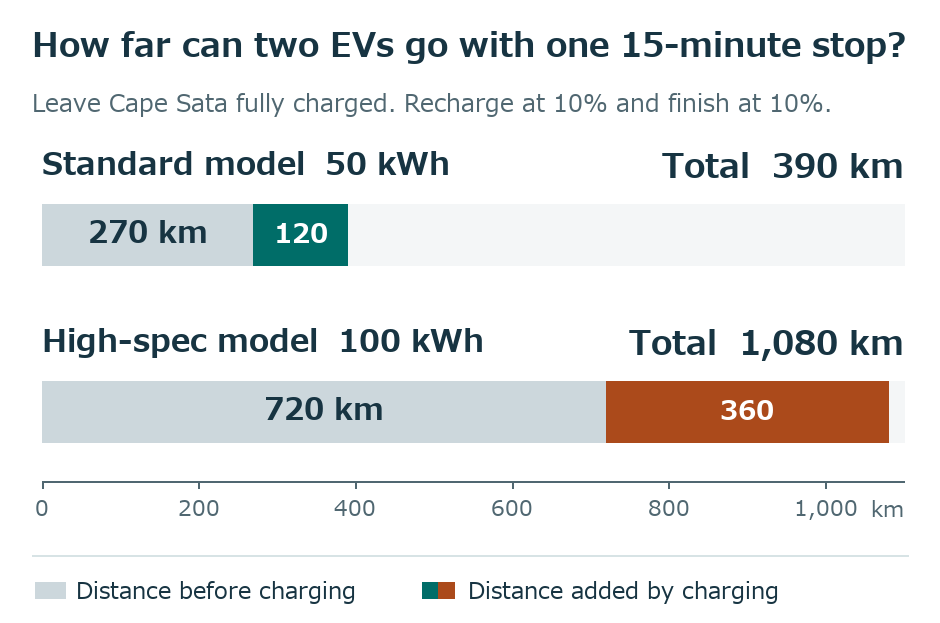
Start with the standard model. Driving from a full 50 kWh battery down to 10% uses 45 kWh. At 6 km per kWh, that first leg is 45 × 6 = 270 km.
Now plug in for 15 minutes, or a quarter of an hour. At an average of 80 kW, the battery gains 80 × 0.25 = 20 kWh. That’s 40% of the 50 kWh battery, so the gauge rises from 10% to 50%. Driving back down to 10% gives us another 20 × 6 = 120 km. Add that to the first 270 km and the total is 390 km.
The high-spec model can use 90 kWh of its 100 kWh battery on the first leg. At 8 km per kWh, that’s 720 km before the stop. Its 15-minute charge adds 180 × 0.25 = 45 kWh, taking the gauge from 10% to 55%. Those 45 kWh buy another 360 km, for a total of 1,080 km.
Here’s what caught my eye. When the two cars unplug, the gauges read 50% and 55%. They look almost the same. Yet one battery gained 20 kWh and the other gained 45 kWh. With batteries this different in size, it helps to ask how much energy went in and how far that energy will take you.
Following the roads north from Cape Sata
Cape Sata lies at the southern tip of the Osumi Peninsula in Kagoshima Prefecture. The last stretch to the lookout is a footpath, so I started the cars at the entrance to Cape Sata Park’s No. 1 parking lot. I used the Python tool from my earlier post to find the shortest distance along major roads to each destination. Both cars can use expressways and bridges. Ferries are excluded. Local guide to Cape Sata (in Japanese) · How I mapped EV driving range with Python
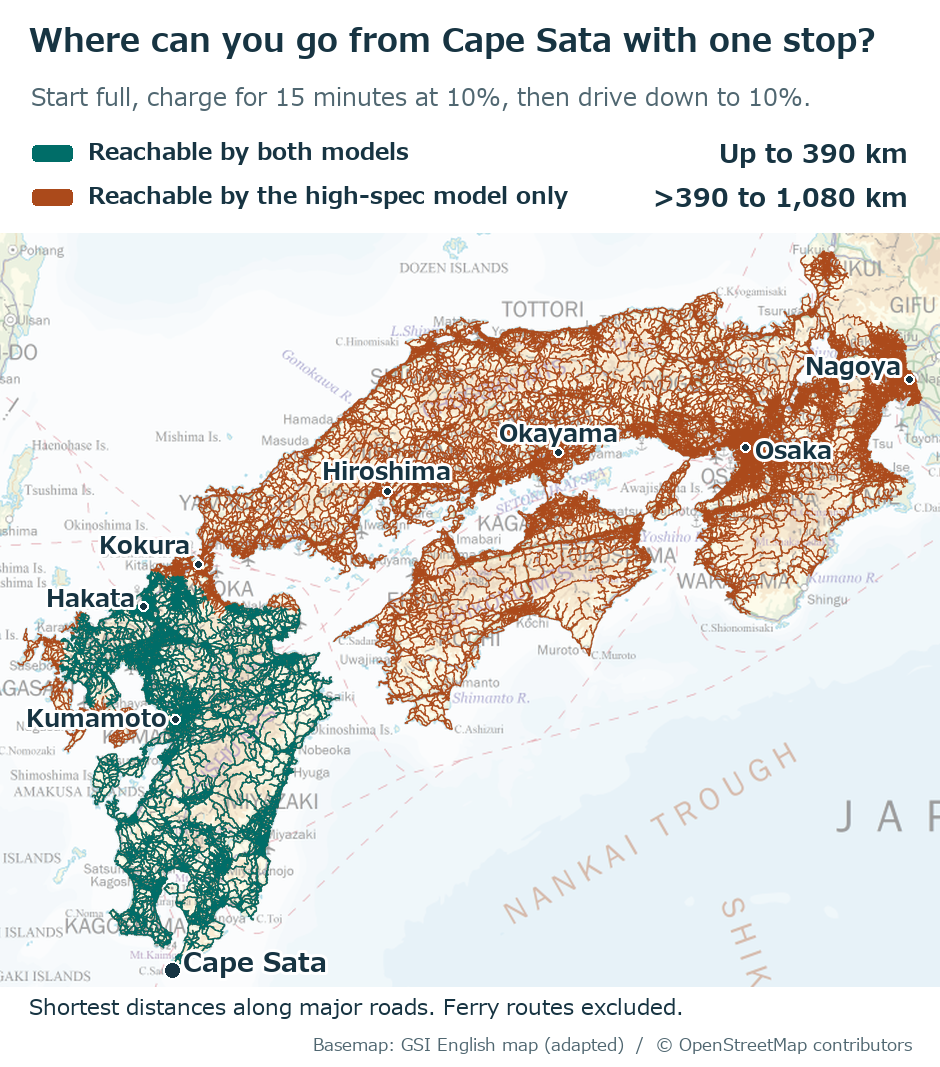
The standard model can reach the area around Kumamoto Station (about 257 km) on its initial charge. Add the 15-minute stop and it can reach Hakata Station in Fukuoka (about 362 km). Kokura Station is about 408 km from the cape, leaving the car roughly 18 km short.
The high-spec model makes it past Osaka. The main road near Nagoya Station is 1,075.7 km from the parking lot, just inside the car’s 1,080 km range. That leaves a margin of 4.3 km. Even a small drop in efficiency could put Nagoya out of reach. Farther east, Mikawa-Anjo Station is already outside the range at about 1,092 km.
| Station area | Road distance from Cape Sata (approx.) | Standard model | High-spec model |
|---|---|---|---|
| Kumamoto | 257 km | Before charging | Before charging |
| Hakata | 362 km | After the stop | Before charging |
| Kokura | 408 km | Out of range | Before charging |
| Hiroshima | 605 km | Out of range | Before charging |
| Himeji | 840 km | Out of range | After the stop |
| Osaka | 923 km | Out of range | After the stop |
| Nagoya | 1,076 km | Out of range | After the stop |
| Mikawa-Anjo | 1,092 km | Out of range | Out of range |
Each row treats the station as a separate destination. I measured to a nearby main road and accounted for one-way streets. Individual turn restrictions and temporary road closures fall outside the model.
I also assumed that an identical high-power charger would be available wherever each car reached 10%. On a real trip you would have to find one. A cold battery or a charger sharing power with another car could deliver less energy in those 15 minutes. Highway speeds and long climbs can change how far each kWh takes you, too.
How much difference does charging speed alone make?
The two cars finish 690 km apart. Battery size and efficiency both contribute to that gap. To see what the charging stop itself is worth, let’s keep the high-spec car’s 100 kWh battery and 8 km/kWh efficiency and change just its average charging power.
At 80 kW, the car gains 20 kWh in 15 minutes, enough for another 20 × 8 = 160 km. At 180 kW, it gains 45 kWh, enough for 45 × 8 = 360 km. Add the same first leg of 720 km in both cases and the totals come to 880 km and 1,080 km. In the same car, spending the same 15 minutes at the charger, that’s a 200 km difference.
Would one coffee stop get you where you want to go?
Under these assumptions, a full battery and one 15-minute stop would take the standard model from Cape Sata to the area around Hakata Station. The high-spec model could reach the area around Nagoya Station.
If I were choosing an EV for trips to see family or for a long holiday drive, I’d look at battery capacity and efficiency, then ask one more question. How much driving range could I get back during a break I’d take anyway?
The Python calculation behind the distances
def drive(usable_kwh, km_per_kwh, avg_charge_kw):
    first_kwh = usable_kwh * 0.90
    added_kwh = min(avg_charge_kw * 15 / 60, first_kwh)
    return first_kwh * km_per_kwh, added_kwh * km_per_kwh

print(drive(50, 6, 80))    # 270 km, 120 km
print(drive(100, 8, 180))  # 720 km, 360 km
Sources behind the two hypothetical EVs
Japan has production EVs with batteries larger than 100 kWh. A government document gives roughly 6–7 km/kWh as a guide for passenger EVs. One particularly efficient car sold in Japan has a published AC consumption figure of 129 Wh/km. That figure includes charging losses. I assumed 8 km/kWh on the battery side for the high-spec car.
Published 10% to 80% fast-charging times for cars sold in Japan include examples of about 20 minutes and about 35 minutes. I used these as benchmarks and chose round figures for the exercise. The efficiencies and the average charging powers over 15 minutes are assumptions for the two fictional cars. Battery capacity example · Government efficiency estimate · Japanese-market AC consumption figure · 20-minute charging example · 35-minute charging example
Japan also has charging equipment rated at up to 350 kW at a single outlet when one compatible car has it to itself. The power delivered and how long it can be sustained depend on the car and the charger. High-power charger example in Japan


コメント